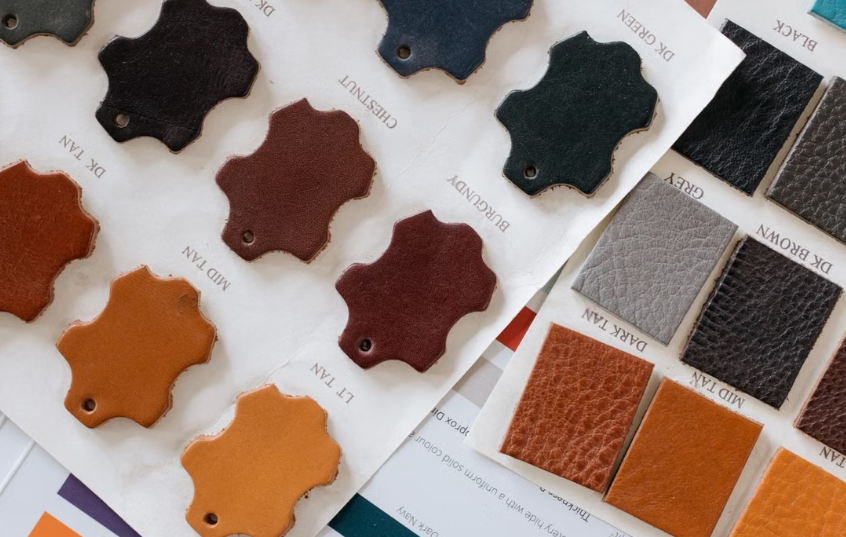
The hidden pitfall of visual shade matching
One of the most frequent friction points in B2B leather sourcing is color variance between the initial sample swatch approved in a designer's studio and the bulk production run delivered weeks later. A shade that looks immaculate under warm incandescent showroom lights can shift dramatically when inspected under natural daylight in a retail window.
At our manufacturing units in the Calcutta Leather Complex, eliminating this variance requires strict adherence to international lighting standards and instrumental colorimetry. Here is how rigorous color control protects your brand's collections.
1. Understanding Metamerism in Dyed Leather
Metamerism occurs when two colored leather samples appear to match perfectly under one light source (such as office fluorescent lighting) but mismatch completely under another (such as natural sunlight or standard store spotlights).
- Dye Formulation Causes: This happens when the chemical dye recipe of the bulk production batch uses different colorant pigments than the master swatch, even though they reflect a similar spectral curve under one specific wavelength.
- The Solution: Standardizing inspection protocols under universal artificial daylight eliminates subjective human guesswork and prevents costly production rejections.
2. The D65 Standard: Simulating 6500K Daylight
In professional quality control, D65 represents the international standard artificial daylight illuminant defined by the International Commission on Illumination (CIE).
D65 simulates average midday northern sky daylight with a correlated color temperature of approximately **6500 Kelvin**. Every custom color formulation developed at our tannery must pass visual evaluation inside a calibrated light cabinet equipped with D65 tubes, alongside auxiliary A (tungsten) and TL84 (store lighting) sources to verify metamerism resistance.
| Illuminant Source | Color Temperature | Primary Inspection Purpose |
|---|---|---|
| D65 (Artificial Daylight) | 6500K | Standard baseline for outdoor daylight simulation and primary shade approval |
| TL84 / CWF (Store Lighting) | 4000K / 4150K | Checking appearance under commercial retail fluorescence |
| Illuminant A (Tungsten) | 2856K | Evaluating warmth and evening showroom presentation behavior |
3. Instrumental Colorimetry and Delta E ($\Delta E$) Thresholds
Visual inspection alone is never enough for high-volume manufacturing. Our QC division utilizes spectrophotometers to measure precise color coordinates in CIELAB ($L^* a^* b^*$) color space.
By comparing numerical values of lightness ($L^*$), red-green axis ($a^*$), and yellow-blue axis ($b^*$), we calculate the total color difference, known as Delta E ($\Delta E$).
- Strict Tolerances: For luxury handbag and footwear programs, we maintain a strict $\Delta E < 1.0$ threshold against the approved master physical standard, guaranteeing seamless panel-to-panel color harmony.
- Digital Archiving: Approved master shade values are stored digitally on file, ensuring exact replication across subsequent production seasons years later.
Conclusion: Precision engineering for predictable results
Color consistency is a hallmark of professional manufacturing. By establishing strict D65 daylight testing protocols and instrumental $\Delta E$ quality controls at our Calcutta Leather Complex facilities, we ensure that every square foot of finished leather delivered to your workshop aligns precisely with your design expectations.